The Definitive Guide To Shopify Personalization
An exhaustive guide on shopify personalization that covers AI product recommendations, agentic commerce, state of eCommerce and everything else.

What Is Shopify Personalization?
Shopify personalization is the process of dynamically adapting your store’s content including product recommendations, pricing offers, and marketing messages to each individual shopper. It’s typically based on their browsing behaviour, purchase history, real-time session context, and explicitly stated preferences.
Instead of showing the same homepage, products, and promotions to every visitor, a personalized store shows what a specific person in most likely to buy, further, increasing the chances of conversions.
Personalization in eCommerce works across multiple touchpoints, be it the homepage a first-time visitor sees, the recommendations they see mid-browse, the upsells offered at checkout, and even the email sent 48 hours after delivery. Each interaction is backed by data processed by AI, and delivered in real time. When done well, it makes each shopper feel special and a store that genuinely understands its customer needs.
However, three terms get mixed constantly.
- Personalization is automatic and merchant-driven: The system figures out what each user wants without being told.
- Segmentation is coarser: It puts customers into buckets and applies the same rule to the whole bucket.
- Customisation is user-driven: A shopper who picks their size or preferred colour.
The gap between segmentation and true personalization is the same as marketing to a group and serving an individual. Only one of those compounds over time.
Personalization is not a feature. It’s an architecture a store is built on. Every interaction feeds a data model and every data model makes the next interaction more relevant. This compounding loop is what separates a great online store from a good one.
The Problem With Personalization in 2026
78% of top-performing Shopify stores now use AI-powered personalization. If your store still shows the same homepage to a first-time visitor and a customer who has bought from you six times, you are not just behind. You are funding the stores that figured this out in 2024.
The question that most founders, VPs, and marketers are asking, “whether or not to personalise,” that’s a debate that ended somewhere in 2023 itself. AI personalization is no longer a “nice-to-have” feature. It’s rather an essential one that defines your business’s prowess in 2026 and the years to come.
The question now is whether your personalization is actually good. Because bad personalization does not just underperform, it actively hurts your business in real-time.
Irrelevant recommendations essentailly are teaching shoppers to ignore your suggestion blocks entirely. Sending the same cart abandonment emails to every segment is one of the fastest ways to destroy your deliverability. And over-targeting on thin data creates the thing nobody talks about, including the uncanny valley effect, and where a shopper feels surveilled rather than understood. That feeling drives churn.
There is also a new problem that barely existed two years ago - AI shopping agents. Shoppers are now asking tools like ChatGPT and Gemini for gift recommendations, compare products on Perplexity, and complete purchases through Microsoft Copilot without ever landing on your product page.
If your store is not built for this layer, you are invisible to a growing segment of shoppers who’re ready to purchase right now.

AI Is Running Commerce Now, And Not Just Enhancing It
A version of the AI conversation has been running rince 2021 - AI as the faster intern.
It writes your product descriptions, helps you structure your inbound and outbound email campaigns, and even shows recommendations you would have missed. That version is not wrong. It is just no longer the whole story.
AI in commerce crossed that threshold sometime in 2025 and most eCommerce and D2C companies missed that signal. The question has shifted from “how to use AI in your online store?” to “how to build a store that AI can sell from.” Those are different problems with different answers.
Three Shifts That Changed The Game
Shift 1: From Batch To Real-Time
Most conventional personalization systems ran on nightly batch processing. They updated the model, refreshed the segments, and created static recommendation lists.
Real-time AI processes 4.3 million events per second, updating recommendations within 50 milliseconds of a user action. The difference in conversion rate between real-time and batch personalization is not incremental. It is structural.
Real-time personalization is now table stakes for stores above 5,000 monthly sessions. Below that threshold, batch approaches still work adequately. Above it, every minute of delay costs measurable revenue to an online store.
Shift 2: From Segmentation To 1:1
Segmentation says customers who bought X also bought Y. True 1:1 AI personalization says this specific customer, with their specific history, browsing pattern, device, location, and time of day, is most likely to add Y to their cart right now.
Amazon drives 35% of its revenue through this model. The model is not new. The accessibility of it for Shopify merchants is.
AI product recommendations at the 1:1 level require a continuous learning system, not a rules engine. The system must improve with every interaction, and it does, if the underlying data model is unified rather than fragmented across separate tools.

Shift 3: From On-Site to Everywhere
AI-driven orders on Shopify grew 15-fold in 2025. Many brands like Keen Footwear and Pura Vida are completing transactions through Microsoft Copilot Checkout without customers visiting their Shopify store. According to Shopify's 2025 Global Holiday Report, 64% of shoppers plan to use AI for purchases, rising to 84% among shoppers aged 18 to 24.
On-site personalization is still critical. But the perimeter of where personalization must work has expanded far beyond your storefront.
The Glood.AI Commerce Intelligence Ladder
Most merchants will tell you they are 'doing some personalization.' What they usually mean is that they installed a recommendations app and set up a cart abandonment email. That is not wrong, but it is not a strategy either. Glood.AI’s product recommendation Shopify app locates exactly where you are and tells you what it would take to move up. It tells you where exactly you must place recommendations to increase revenue impact. For instance,
- Homepage personalization is key for all eCommerce brands because it makes a shopper go deeper into your site.
- Placing personalization widget on product pages helps uplift average order value
- Placement on checkout helps increase upsells.
Personalization on homepage allows you to show different content to different groups - logged-in vs. guest, new vs returning. The homepage banner swaps. Promotions go out to segments. Nothing adapts to what a visitor is doing in real-time. Such adaptation helpsn increase store revenue anywhere between 20 to 35%.
Meanwhile, behavioural adaptation also plays a critical role.
- The store reacts to what a visitor does in their current session.
- Products recently viewed show in recommendation rails.
- Category-based filtering updates as the customer browses.
- Cart cross-sells match what is in the cart rather than showing generic bestsellers.
This again helps capture the untapped revenue margin.
Next comes predictive personalization. By leveraging this, the tool combines current sesion behaviour with historical purchase and browsing data to predict what each individual is likely to want next, before they signal it explicitly.
A returning customer who has bought running shoes twice and browsed compression gear three times sees compression socks recommended on their next product view, without ever searching for them. This is the level at which personalization stops feeling like a feature and starts feeling like good service.
Glood.AI’s commerce intelligence layer, lastly predicts purchase intent and personalizes every touchpoint simultaneously, be it on-site, email, in SMS, in past-purchase flows, and in the agentic AI channels where your customers are increasingly shopping. The system improves without manual intervention. The store has a data model for each customer that gets more accurate with every interaction.
The practical result? the engine at Day 90 is measurably better than on Day 1 without anyone touching it. That compounding is the whole point.
Glood.AI is built to move merchants up the ladder, starting from wherever they are. The model begins learning on day one and gets more accurate as it logs behaviour specific to your store and your customers.
Zero-Party Data: The Fuel AI Needs
Third-party cookies are gone. The audience data bought from ad platforms and the behavioural inference layers built on top of it are unreliable in ways they were not three years ago. What is left, and what has become the most valuable raw material in
eCommerce personalization, is zero-party data: information customers give you deliberately.
Zero-party data is information customers give you on purpose: the skin type they enter in a diagnostic quiz, the budget they set in a gift finder, the style preferences they share in an onboarding flow. Unlike behavioural data, which requires inference, zero-party data is the customer telling you directly what they want. It does not expire. It does not require a consent banner. And it makes the AI meaningfully smarter because you are feeding it signal instead of proxy.
Why It Outperforms Everything Else
- No inference required. The customer stated directly what they want.
- Fully consent-based, with no regulatory risk and no tracking concerns.
- More durable. It does not expire when a cookie window closes.
- Higher personalization accuracy because you work from stated preference, not proxy signals.
Here's how real brands collect it at scale:
- Sephora: Customers share skin tone, undertone, and product preferences through Virtual Artist and Color Match. Sephora feeds this directly into product recommendations and marketing. The personalization feels like a service rather than surveillance.
- Stitch Fix: Before shipping anything, Stitch Fix asks customers more than 50 questions about style, fit, body type, and lifestyle. That profile does not just power the first box. It is the foundation of every AI decision the platform makes going forward.
- Shopify quiz funnels: A skincare brand's 'find your routine' quiz collects concern type, current products, budget, and frequency preferences. Buyers who complete it convert three to four times higher than those who do not, because every recommendation that follows is genuinely relevant.
Building Your Zero-Party Data Collection
The most effective zero-party data collection turns the data exchange into an experience that gives the customer something useful. A quiz that recommends a personalised skincare routine is valuable to the customer independently of what it does for your personalization engine. That value-first design is what drives completion rates above 50%, versus the 10 to 15% completion rates of forms framed purely as data collection.
By product category, the most effective quiz formats are: for beauty and skincare, a diagnostic tool that outputs a personalised routine; for fashion, a style profile that surfaces a curated lookbook; for supplements and health, a goals-based assessment that recommends a protocol; for home decor, a style quiz that generates a room mood board. The output must be immediately useful, or the completion rate will not justify the investment.
A Forrester survey found 31% of adults will share personal information for cash rewards and 22% will do it for loyalty points. The data shows that customers are willing to share when the value exchange is clear. The brands failing at zero-party data collection are the ones asking for information without giving anything back.
Agentic Commerce: The Discovery Layer Nobody Has Optimised For
Picture this. A customer opens ChatGPT and types: find me a gift for my partner who likes minimal jewellery, budget around $60. What comes back is not ten links and a suggestion to filter by price. It is three specific products, with prices, reviews, and a buy button that works inside the conversation.
That is agentic commerce. It is not coming. It is already here, and it is growing faster than most merchants realise.
What Is Happening Right Now
- Shopify's Agentic Storefronts let merchants appear in ChatGPT, Microsoft Copilot, Perplexity, and Google AI Mode in Search.
- Microsoft Copilot Checkout and Perplexity's Instant Buy allow purchases inside the AI conversation itself.
- AI-driven orders on Shopify grew 15-fold in 2025. The Universal Commerce Protocol, co-developed by Shopify and Google, standardises how AI agents handle checkout flows, discount codes, loyalty credentials, and subscription billing.
- 64% of global shoppers plan to use AI when making purchases. Among shoppers aged 18 to 24, that figure is 84%.
Why Most Stores Are Not Ready
AI shopping agents do not browse the way humans do. They parse structured product data, titles, descriptions, specifications, FAQs, use cases, and metafields, to match conversational queries to products. A product with a thin description, inconsistent categorisation, and no FAQ coverage is invisible to an AI agent regardless of how well it converts on your own PDP.
Your product catalog is now a primary marketing asset for
AI product recommendations across external AI channels. The way you structure and enrich it determines whether AI agents surface your products or your competitor's when a shopper asks a relevant question.
What Being AI-Ready Actually Means in Practice
- Full product descriptions: Paragraphs that answer contextual questions, best for, works with, not recommended for, what makes this different from alternatives. Not bullet points.
- Scenario-based metadata: AI agents prioritise content that matches conversational queries. A heading like 'best for long-haul travel' wins over a generic feature list when a customer asks about travel gear.
- Active Knowledge Base: Your brand voice, FAQs, return policies, and comparison points, structured so AI agents answer questions about your brand accurately.
- Clean taxonomy: Shopify Catalog uses signals from millions of merchants to standardise product data. Accurate categorisation and complete attributes determine how often AI systems select your products for relevant queries.
Leading brands like Target Australia saw over 13 million AUD in search revenue increases by personalising results and automating metadata with a focus on accuracy. Your product data is your discoverability, in search and in AI.
What Real Personalization Looks Like: 11 Brand Examples
Personalization is one of those words that means everything and nothing until you see it working. Here is what it looks like at brands that have built it into their core operations.
1. Amazon: Dynamic Title Personalization
Amazon changes product titles based on who is looking at them. A shopper who keeps clicking on lightweight gear sees 'Ultra-Light Trail Running Shoe, Best for Long-Distance.' A price-focused buyer sees 'Best Value Running Shoe, Under $80.' Same product. Same URL. Different headline. The AI identifies what each individual cares about and puts that attribute first. This is not a feature. It is an entire product philosophy, and it drives 35% of Amazon's total revenue. Worth understanding before you decide a recommendations widget is enough.
2. Stitch Fix: The Feedback Loop That Compounds
Most eCommerce brands track what customers buy. Stitch Fix tracks why they kept it. After every box, customers rate each item and explain what worked. That feedback goes back into the model immediately. After five boxes, the match rate on items customers keep is dramatically higher than after the first. The difference is not the algorithm. It is the feedback loop. Purchase data tells you what happened. Taste data tells you why, which is far more useful.
3. Sephora: Zero-Party Data as Product Strategy
Sephora's Virtual Artist is not just an AR feature. It is a systematic zero-party data collection mechanism. Every time a customer uses it to try on a shade or match a foundation, Sephora records preferences impossible to infer from purchase data alone, undertone, finish preference, skin concern. The result is a personalized shopping experience that accounts for individual skin characteristics rather than just category and price range.
4. Misfits Market: Pre-Loading Carts With AI
Misfits Market does something that sounds aggressive until you think about it: they pre-load your cart. The algorithm predicts what you are likely to want based on purchase patterns across hundreds of thousands of customers with similar taste profiles, and puts those items in before you open the app. You remove what you do not want. Most people do not remove much. Their CSO Kai Selterman put it simply: the store should show each customer the products they love, not make them hunt. Hard to argue with that.
5. IKEA: AI That Identifies Products From Photos
IKEA's AI assistant lets customers upload room photos and receive recommendations for complementary furniture identified from the image rather than from a category menu. The customer does not need to know what style a chair is. They show the AI their living room. Within months of launch, 20% of AI assistant interactions led to store visits, demonstrating that visual-AI discovery converts at rates comparable to high-intent search.
6. Keen Footwear: Selling Through Copilot
Keen Footwear was among the first Shopify brands to enable Microsoft Copilot Checkout. Customers discover and purchase Keen products directly inside a Copilot conversation without visiting the store. The brand structured its product data to be AI-legible, detailed descriptions, use-case categorisation, and rich metafields, before the agentic channel went live. That groundwork made the integration possible without custom engineering.
7. Burger King: Hyper-Personalised Creative at Scale
Burger King's Million Dollar Whopper campaign used AI to crowdsource ideas and generate thousands of ads with video, audio, and text built around individual consumer profiles. The same product was presented through the lens of each viewer's demographic and behavioural data. D2C brands are now applying this model to email creative, push notifications, and social retargeting.
8. AutoZone: Geo-Personalization That Closes the Loop
AutoZone uses geolocation to show real-time product availability based on the customer's nearest store. For automotive parts, where timing is critical, a buyer who needs a specific filter today cannot wait for shipping. The geo-personalized store feels like a local resource rather than a distant warehouse, and it converts time-sensitive purchases at significantly higher rates than generic inventory displays.
9. Cambridge Satchel: AR That Reduces Returns
Cambridge Satchel added AR to their Shopify store using Shopify's native AR capabilities, letting customers visualise how a bag looks with their wardrobe. Shoppers using AR are 40% less likely to return products and spend twice as long on PDPs. For a premium leather goods brand where returns carry significant margin cost, personalization of the decision-making experience directly improves profitability.
10. Rare Beauty: Shade Finder as Personalization Engine
Rare Beauty uses an AI-powered shade finder that generates personalized product recommendations from a customer's skin tone photo. The tool generated 1,500 or more personalised recommendations and 4 million social impressions from popup activations. Personalization here is not just a website feature, it is the centrepiece of the brand's physical and digital retail strategy simultaneously.
11. A Mid-Sized D2C Skincare Brand Using Glood.AI
A brand with around 40,000 monthly visitors implemented Glood.AI across their store. The homepage showed returning visitors their most recently viewed categories. PDPs showed frequently-bought-together bundles based on actual co-purchase data. Cart cross-sells surfaced items that closed the free-shipping gap, personalised to current cart contents. The post-purchase page offered a complete-your-routine add-on relevant to the product just purchased. Six weeks later: AOV up 22%, repeat purchase rate up 18%, cart abandonment down 14%. No discounts were required. Only relevance.
On-Site Personalization Done Right
Homepage: Different Jobs for Different Visitors
The homepage does two different jobs simultaneously: acquiring new customers and re-engaging returning ones. A single static design fails at both. A personalised homepage adapts dynamically to whoever is viewing it, and the adaptation starts with the most fundamental split of all.
- New Visitors: You know almost nothing about a first-time visitor. What you do know is where they came from. A visitor from a Facebook ad about a summer collection should land on that collection, not a generic hero banner. Someone from a Google search for 'best lightweight moisturiser' should see your best-rated moisturisers first. Referral source context, geolocation, and device type are the three signals that make even a first visit feel intentional. Whatever the visitor clicks in the first 60 seconds updates what they see on the next page: the earliest form of in-session behavioural targeting.
- Returning Visitors Without a Purchase: These are your highest-value unconverted prospects. They know your brand. They have browsed. Something stopped them from buying. Surface the products they viewed most recently. Show social proof, ratings, purchase counts, review snippets, on items they have engaged with multiple times. If they have visited three or more times without purchasing, a targeted entry offer becomes justifiable. The offer should be relevant to what they actually browsed, not a generic sitewide discount.
- Returning Customers: Get them to the right product quickly. A continue-shopping rail that surfaces recently viewed items consistently reduces bounce rates by 15 to 25% for returning customers. Showing new arrivals in their most-purchased categories works better than sending them through a full navigation menu. A complete-your-collection nudge moves them toward adjacent purchases that fit their established history.
Product Detail Page: Personalization At The Decision Moment
The PDP is where purchase decisions are made. Personalization here has two jobs: remove the last objections and raise the size of what goes into the cart.
- Customers Also Bought: Collaborative filtering at its most effective. On high-traffic PDPs, this section alone drives 15 to 20% of cart additions when the recommendations are genuinely relevant rather than generic bestsellers.
- Frequently Bought Together: Bundle recommendations with clear value framing. A customer buying a yoga mat should see the matching block and strap without having to search for them.
- Complete the Look or Complete the Set: For fashion and home categories, aspirational merchandising outperforms utility recommendations. Sell the vision, not just the individual SKU.
- Reviews From Buyers Like You: Dynamically surfacing reviews from customers with similar profiles, same skin type, same body measurement, same use case, increases review trust and purchase confidence more than aggregate reviews alone.
Search: High Intent, Low Personalization - A Major Gap
Search is the highest-intent touchpoint in any store because searchers have already decided they want something. Yet it is where personalization is most often absent. A personalised search engine re-ranks results based on individual history. A returning customer who consistently buys premium products does not need entry-level options crowding their results. Their search for sneakers should surface the premium tier first.
Predictive autocomplete personalised by browsing history surfaces relevant query suggestions faster than generic autocomplete. When search returns zero results, a personalised zero-result page shows alternatives from the visitor's most-browsed categories, converting a dead end into a discovery moment that keeps the session alive.
Tools that enable search personalization on Shopify include Boost Commerce, Searchie, SearchPie, and Fast Simon. Each integrates with behavioural tracking to re-rank results per visitor. The setup time for most is under two hours. The conversion rate improvement on high-intent search traffic typically ranges from 8 to 15%.
Cart: More Than a Summary Screen
The cart's job is to get the customer to checkout with the highest possible order value. Personalization's role here is precision: the right add-on, at the right moment, without adding friction to the checkout flow.
- Threshold Nudges: Add $10 more for free shipping, paired with a cross-sell recommendation that hits exactly that gap. The product suggested and the threshold message must work together or neither performs well independently.
- Relevant Cross-Sells: Cross-sells that match cart contents convert at three to five times the rate of generic bestseller rails. Running shoes in the cart means performance socks in the cross-sell, not a random accessory.
- Social Proof at the Decision Moment: Showing that 94 people bought this product in the last 30 days validates the customer's decision at the moment of maximum uncertainty.
- Personalised Discount Logic: Not every customer needs a discount to convert. A high-intent returning customer who has bought three times before should not see a 15% off pop-up that erodes margin. Reserve offers for sessions showing genuine abandonment signals.
The Post-Purchase Window Nobody Is Fighting Over
The 20 minutes after a purchase are the highest-trust moment in any customer relationship. The payment went through. The decision feels good. The customer is thinking about the brand. And 90% of stores respond by sending a generic order confirmation and going dark for three days. That window is worth fighting for. Most brands leave it completely empty.
The Post-Purchase Upsell
The post-purchase upsell is the cleanest offer structure in eCommerce. The payment is already processed. The customer just said yes to your brand. Present a single, relevant offer: one product, one decision, one click, with no cart re-entry required. For well-targeted offers, where the product genuinely complements what was just purchased, conversion rates of 8 to 18% are consistently achievable. The key constraint: the offer must be a one-click accept with no additional checkout steps. Any additional friction collapses conversion to near zero.
Glood.AI automates this by surfacing the product from your catalogue most likely to be accepted as an add-on by a customer with this specific profile who just purchased this specific item. The offer is different for every buyer, and the acceptance rate reflects that specificity.
The Thank-You Page: Repurpose It
The thank-you page gets the highest view rate of any post-purchase touchpoint because every customer lands there. Most merchants waste it on a static order confirmation. A personalised thank-you page should include a relevant recommendation block, an invitation to join your loyalty programme with the points they just earned shown explicitly, a referral offer with a clear incentive for both parties, and a brand moment that reinforces why they made a good decision. Merchants who personalise this page see 10 to 25% of buyers click through to an additional product.
Replenishment: The Recurring Revenue Most Brands Miss
For consumable products, supplements, skincare, coffee, pet food, candles: the biggest missed opportunity is the second purchase, not the first. A replenishment email sent at the predicted run-out date converts at dramatically higher rates than any promotional campaign because it is useful rather than sales-driven. Calculate average consumption rate from your purchase data, add 10 to 14 days of lead time, and trigger the reminder before they run out. Make reordering frictionless: one click, pre-filled cart. This single sequence increases repeat purchase rates by 15 to 25% for consumable brands without requiring a discount.
Cross-Category Discovery After the First Purchase
A customer's first purchase reveals their taste. A buyer of your premium serum is a warm lead for your vitamin C SPF. Someone who bought running shoes is ready to hear about compression socks. The post-purchase email sequence should introduce them to adjacent categories framed as a discovery rather than a sale. The first purchase gives you the right to recommend. Use it within 72 hours while the brand relationship is at its highest engagement.
Upsell and Cross-Sell: The Math Behind AOV Growth
A 20% increase in average order value optimization on a $50 average order means $10 more per transaction. At 2,000 orders a month, that is $20,000 in additional revenue from the same traffic, the same ad spend, and the same customer base. AOV improvement is one of the highest-return interventions in eCommerce because it requires no additional customers.
Upsell vs Cross-Sell: The Practical Difference
An upsell encourages the customer to buy a higher-value version of what they are considering. A cross-sell introduces complementary products that enhance the primary purchase. Both drive AOV but apply at different stages and require different creative approaches. Mixing them up produces weak results from both. The rule: present the upsell before the customer commits to the original product, and present the cross-sell after they have added it to cart.
Where Each Works Best
- Upsell on PDP, before adding to cart: show the premium version with a specific value comparison, 'the 250ml lasts 3 months vs 90 days for the standard size.'
- Upsell in cart: upgrade to bundle framing with the exact price difference stated, 'get all three for $12 more.'
- Cross-sell in cart: items that complete what is already in the cart, not generic bestsellers.
- Cross-sell post-purchase: one-click add-on with no re-checkout required. 8 to 18% acceptance rate when relevant.
Bundle Personalization: The AOV Multiplier
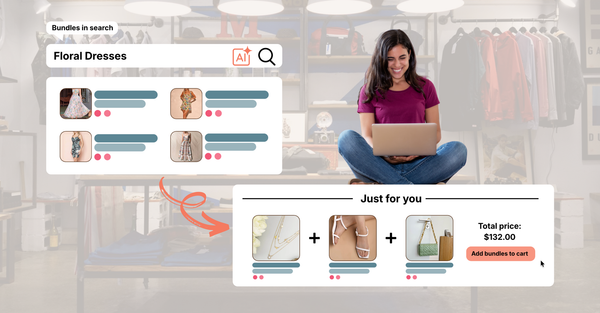
AI-powered bundle recommendations surface the three or four products most likely to be purchased together by shoppers with this customer's profile. This is more accurate than manually curated bundles, and it adapts in real time to inventory changes, seasonal shifts, and updated co-purchase patterns. Acceptance rates for personalised bundles run 30 to 50% higher than generic bundles because the combination reflects actual purchasing behaviour rather than editorial judgment.
A Worked Example at Two Store Sizes
Store A does $100,000 per month in revenue with a $60 average order value and 1,667 monthly orders. After implementing personalised bundle recommendations and cart cross-sells, AOV rises to $72. Revenue from the same traffic: $120,000. The incremental $20,000 per month funds the personalization tool cost several times over.
Store B does $1 million per month with a $120 average order value and 8,333 monthly orders. After implementing the full personalization stack including post-purchase upsells and dynamic email blocks, AOV rises to $144. Revenue from the same traffic: $1.2 million. The incremental $200,000 per month is pure additional profit from existing customers.
The math works proportionally at every store size. The tool cost is fixed. The revenue benefit scales with order volume.
Personalization by Vertical: Five Categories, Five Strategies
No guide on eCommerce personalization covers this. The strategies that work for a fashion brand differ fundamentally from those that work for a supplements brand. Data signals differ. Purchase cycles differ. The uncanny valley threshold, where personalization starts feeling intrusive, falls at different points. Here is what the five most common D2C verticals need from personalization, specifically.
Fashion and Apparel
Fashion personalization is visual and aspirational. The primary signals are: categories browsed, price tier engaged, size selected, style tags viewed (minimalist vs. bold, casual vs. formal), and return rate per item type, because a customer who returns every slim-fit item is telling you their preferred cut without saying it explicitly.
The highest-impact personalisation for fashion: complete-the-look recommendations that assemble an outfit around the item being viewed, size-aware recommendations that surface styles with good fit reviews from customers with similar measurements, and personalised new-arrival alerts by style category for customers with established taste profiles. The zero-party data mechanism that works best in fashion is a style quiz that outputs a 'your personal edit' collection page populated with items that match the stated profile.
Fashion brands should also personalise their sale communications. A customer who only ever buys at full price should not receive a 40% off promotion email. A customer who exclusively buys during sales should not receive new-collection emails at full price. Both groups exist in every fashion brand's customer base, and treating them identically is a margin and relationship problem simultaneously.
D2C personalization in fashion scales most effectively when the brand treats outfit building, not individual product, as the unit of personalization.
Beauty and Skincare
Beauty is the vertical with the most available zero-party data opportunity. Customers are willing, eager, even, to share skin type, concerns, undertone, and routine details in exchange for personalised recommendations. A brand that does not collect and act on this data is leaving its most valuable personalization asset unused.
The highest-impact personalization for beauty: skin-profile-based recommendations that account for concern type (acne, ageing, hyperpigmentation) and formulation preferences (fragrance-free, oil-free, retinol-free), routine completion recommendations that surface the next logical step based on products already purchased, and replenishment timing that matches product usage rates. A cleanser used twice daily runs out in about 60 days for a 150ml bottle. A personalised replenishment email at day 50 converts at rates that promotional campaigns cannot approach.
Beauty brands should also personalise their search heavily. A customer who has indicated oily skin should see oil-control products ranked first for ambiguous queries like 'moisturiser' or 'foundation.' This requires search personalization integration rather than simple keyword-matching.
Health and Supplements
Supplements personalization is goals-based. The most effective data signal is stated intent: a customer who bought a protein supplement and a pre-workout is building muscle. A customer who bought magnesium and ashwagandha is managing stress and sleep. The AI's job is to understand the customer's wellness goal from their purchase pattern and recommend the next product that serves that goal, not the next bestseller in the category.
The highest-impact personalization for supplements: protocol-based bundle recommendations that group products by wellness goal (energy, recovery, sleep, immunity), subscription upsells on first-purchase products where replenishment is predictable, and content personalization that surfaces educational material relevant to the customer's stated goals alongside product recommendations. A customer trying to improve sleep responds better to a recommendation accompanied by a 'why magnesium helps sleep' explanation than to a product card alone.
Supplements brands also have the highest urgency case for replenishment automation. A 60-count magnesium bottle taken once daily runs out at a predictable date. Missing the replenishment window means the customer either buys from a competitor who reminds them first or stops the habit entirely. The stakes of getting replenishment timing right are higher here than in almost any other vertical.
Home Decor and Furniture
Home decor personalization is room-based rather than item-based. A customer buying a dining table is not looking for another dining table. They are looking for chairs, a rug, pendant lighting, and a sideboard that work with the table they just bought. The personalization challenge is understanding the customer's room context and style aesthetic, then recommending items that complete rather than duplicate.
The highest-impact personalization for home decor: room-context recommendations that surface items in the same style family as the product being viewed, AR personalization that lets customers visualise how an item fits in their specific space (Cambridge Satchel's AR approach applies here), and style-based new-arrival alerts that match the customer's established aesthetic, minimalist, maximalist, Scandinavian, industrial, rather than generic category alerts. Visual search, where customers upload a room photo and receive recommendations for items that match the style, is the emerging personalization frontier in this vertical.
Pet Products
Pet product personalization is profile-based: breed, age, weight, and health condition of the pet determine almost everything about what is relevant. A Labrador Retriever owner buying food has entirely different needs from a Yorkshire Terrier owner. An eight-year-old dog has different supplement needs from a two-year-old. Most pet brands treat all dog owners identically. The ones that collect pet profile data and personalise against it have a structural data moat that is very difficult for generic brands to replicate.
The highest-impact personalization for pet products: pet-profile-based product filtering that removes irrelevant items from recommendations (a cat food recommendation to a dog owner is worse than no recommendation), age and weight-appropriate product surfacing for food and supplements, and health-condition-based bundles for pets with known issues like joint problems or sensitive digestion. The zero-party data mechanism for pet brands is a pet profile form at account creation, breed, age, weight, any known health conditions, that populates every recommendation surface immediately.
The Personalization Cost and ROI Table
One of the most common questions merchants ask before implementing personalization is simple: what does it actually cost, and what can I actually expect back? Here is a realistic breakdown across four revenue tiers, based on typical tool costs and observed revenue lift ranges.
Note: the ranges below represent typical outcomes. Stores at the top of the range have unified data infrastructure, active A/B testing programmes, and personalization implemented across all touchpoints. Stores at the bottom of the range have personalization in one or two places with no systematic measurement.
The consistent pattern across all tiers: the tool cost is a rounding error relative to the revenue uplift. The constraint is never cost. It is implementation quality and data infrastructure.
Measuring What Matters: The 8 KPIs
Personalization affects multiple metrics simultaneously. Tracking conversion rate optimization in isolation misses the compounding picture. You need to see the full chain from relevance to revenue to retention.
Revenue KPIs
- Average Order Value: Track for sessions with personalised recommendations versus sessions without. The delta is your personalization's direct revenue contribution per order.
- Revenue Per Visitor: AOV multiplied by conversion rate. The composite metric that captures both effects simultaneously. Best single number for measuring overall personalization impact.
- Recommendation-Attributed Revenue: The share of total revenue driven by customers clicking personalised recommendation blocks. Track per placement and per recommendation type to identify your highest-performing surfaces.
Engagement KPIs
- Recommendation CTR: Measures relevance quality. Low CTR signals that recommendations are not matching customer intent. Audit placement, algorithm type, or product catalogue completeness.
- Add-to-Cart Rate From Recommendations: Tracks per placement to identify which surfaces drive the most cart additions. Use this to allocate recommendation slots on high-traffic pages.
- Conversion Rate Lift: Always A/B test personalised versus control groups. A 0.5% CVR lift at scale is meaningful incremental revenue, but you will not know it exists without a proper test.
Retention KPIs
- Repeat Purchase Rate: The clearest signal that personalization is building genuine loyalty rather than one-off conversions. Track for 30, 60, and 90-day windows after first purchase.
- Customer Lifetime Value: The compound metric. Higher LTV indicates that personalised experiences are changing purchase behaviour over time, not just individual order sizes.
Setting Up Measurement in Shopify Analytics and GA4
Record your baseline AOV, RPV, CVR, and repeat purchase rate for at least four weeks before implementing any new personalization. In GA4, set up custom events for recommendation_click (fires when a customer clicks a recommendation block), recommendation_add_to_cart (fires when a recommended product is added), and recommendation_purchase (fires when a recommended product appears in an order). These three events give you the full attribution chain from recommendation impression to revenue.
In Shopify Analytics, use the Customer Cohorts report to track repeat purchase behaviour by acquisition month. Compare cohorts from before and after personalization implementation. A cohort acquired after Glood.AI was installed should show higher 30-day and 60-day repeat purchase rates than the equivalent pre-implementation cohort, controlling for seasonal variation.
Run A/B tests on all new personalization features before full deployment. Assign 50% of traffic to the personalised experience and 50% to the control. Run for a minimum of two weeks and until each variant has at least 1,000 sessions. Calculate payback using net revenue benefit divided by monthly tool cost. A payback period under 30 days means the feature should be deployed permanently.
The 90-Day Personalization Playbook
Most personalization failures are not failures of strategy. They are failures of sequencing. Merchants try to do everything at once, measure the wrong things, and conclude that personalization does not work. It does. It needs to be built in the right order.
Days 1 to 30: The Foundation Layer
- Audit your analytics. Confirm that behavioural events, product views, add-to-carts, and purchases, are tracked correctly in GA4 and Shopify Analytics. No personalization engine performs well with incomplete event data.
- Implement AI-powered product recommendations on your 20 highest-traffic PDPs. Customers Also Bought and Frequently Bought Together. Most merchants see the first measurable AOV lift here within 2 weeks.
- Set up cart cross-sells relevant to cart contents rather than generic bestsellers.
- Configure new versus returning visitor homepage split with different hero content, featured products, and messaging for each group.
- Launch a three-part cart abandonment email sequence: reminder with no discount, social proof using reviews on cart items, offer with minimum incentive and a deadline.
Days 31 to 60: Deepen the Engine
- Add post-purchase thank-you page personalization and a single post-purchase upsell offer.
- Set up browse abandonment email trigger. Earlier signal than cart abandonment and often converts better because the product interest is still fresh.
- Add a continue-shopping homepage rail for returning customers.
- Configure replenishment email sequences for consumable products using predicted run-out dates.
- Begin A/B testing: recommendation types, placements, and formats. Let data decide what works best on your specific store rather than assuming the global average applies.
Days 61 to 90: Scale and Compound
- Roll out loyalty programme with personalised tier communication for each segment.
- Implement personalised SMS triggers for high-intent segments: back-in-stock notifications and price-drop alerts on wishlisted items.
- Build RFM segmentation and specific win-back campaigns for At-Risk and Lapsed segments.
- Launch personalised bundle recommendations on PDPs and in the cart.
- Set up the KPI dashboard and measure everything against the baseline recorded on Day 1.
Within 90 days of this sequence, most stores see measurable improvements in AOV of 15 to 20%, repeat purchase rate of 10 to 15%, and email revenue of 20 to 30%. The gains compound after Day 90 because the AI model improves continuously as it learns from your specific customer base.
What Comes Next
Personalization in 2026 is not a feature you add to a store. It is the operating layer the store runs on. The merchants leading in 2028 are the ones building data infrastructure now, unified profiles, AI recommendation engines trained on their specific customers, agentic commerce readiness, zero-party data systems that grow with every quiz completion. The window to build a meaningful data advantage over competitors who have not started is still open. It will not stay open.stems, while the window to build a compounding data advantage is still open.
The compounding is not a metaphor. A store with 18 months of Glood.AI data has a model trained on tens of thousands of actual purchase decisions from its actual customers. A store that starts today has none of that. The gap between them is not a feature gap. It is a knowledge gap. And knowledge gaps grow.
Glood.AI exists so that closing that gap does not require a six-month engineering project. The infrastructure is already built. The models start learning on day one. The only real decision is when you want to start.
Book a free personalization audit with the Glood.AI team. We will map your current store, identify your three highest-revenue personalization opportunities, and show you what results look like for a store at your scale.